
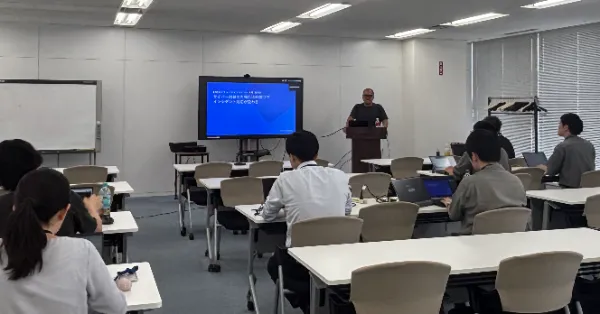
On September 18, 2026, SIGQ Inc. held a study session at the Nagoya office of NEC Solution Innovators, Ltd. on Japan's Active Cyber Defense Act (the Act on Strengthening Cyber Response Capabilities) and our incident management service, Incident Lake.
The day consisted of a lecture on the legal framework and the product in the first half, followed by a hands-on exercise using Incident Lake in the second half. Participants deepened their understanding of the law and experienced ways to make writing initial reports and incident reports go more smoothly when an incident occurs.
First half: The Active Cyber Defense Act and the future of incident response
In the first half, we focused on the Act taking effect and introduced the key points relevant to corporate incident response. We covered topics such as understanding your assets, how to think about "awareness" (the point at which an incident is recognized), recording decisions and the sequence of events during a response, and reporting flows with stakeholders, all from the perspective of how to connect the law to real-world operations.
We also introduced Incident Lake, which supports this kind of response, recording, and reporting. We explained the idea behind it, keeping a chronological record of information during a response and using that record as the basis for initial reports and incident reports, which reduces the burden of re-gathering information after the fact just to report, along with how the product supports this.
How is "awareness" defined? Questions that go to the heart of the work
Participants asked fundamental questions, such as "How is 'awareness' defined under the Active Cyber Defense Act? (What is the trigger point?)"
Beyond understanding the outline of the law, they wanted to know what should serve as the starting point for decisions on the ground and how to translate it into operations. Their questions, focused on concrete responses, showed just how engaged participants were.
Second half: Experiencing everything from the initial report to the incident report with a simulated incident
In the second half, we ran a practical exercise using Incident Lake based on a simulated incident.
Participants operated Incident Lake themselves, sending an initial report and creating an incident report during the exercise. By getting hands-on rather than just listening to a product explanation, they were able to see for themselves how Incident Lake can be used for reporting work when an incident occurs.
By working through scenarios that mirror their actual work, such as preparing an initial report and organizing the sequence of the response into an incident report, participants came away with a concrete picture of how Incident Lake makes reporting easier.
Turning response records into reports
Through an understanding of the legal framework and hands-on experience with the product, this study session was an opportunity to think together with participants about how recording and reporting should work in incident response. We received questions grounded in real-world practice, and it was a very meaningful time for us as well.
We sincerely thank everyone at NEC Solution Innovators who participated, as well as everyone who helped coordinate and support the event.
SIGQ will continue to support frontline incident response and reduce the burden of recording and reporting through Incident Lake. Thank you very much for this valuable opportunity.